使用 Matryoshka 嵌入进行漏斗搜索
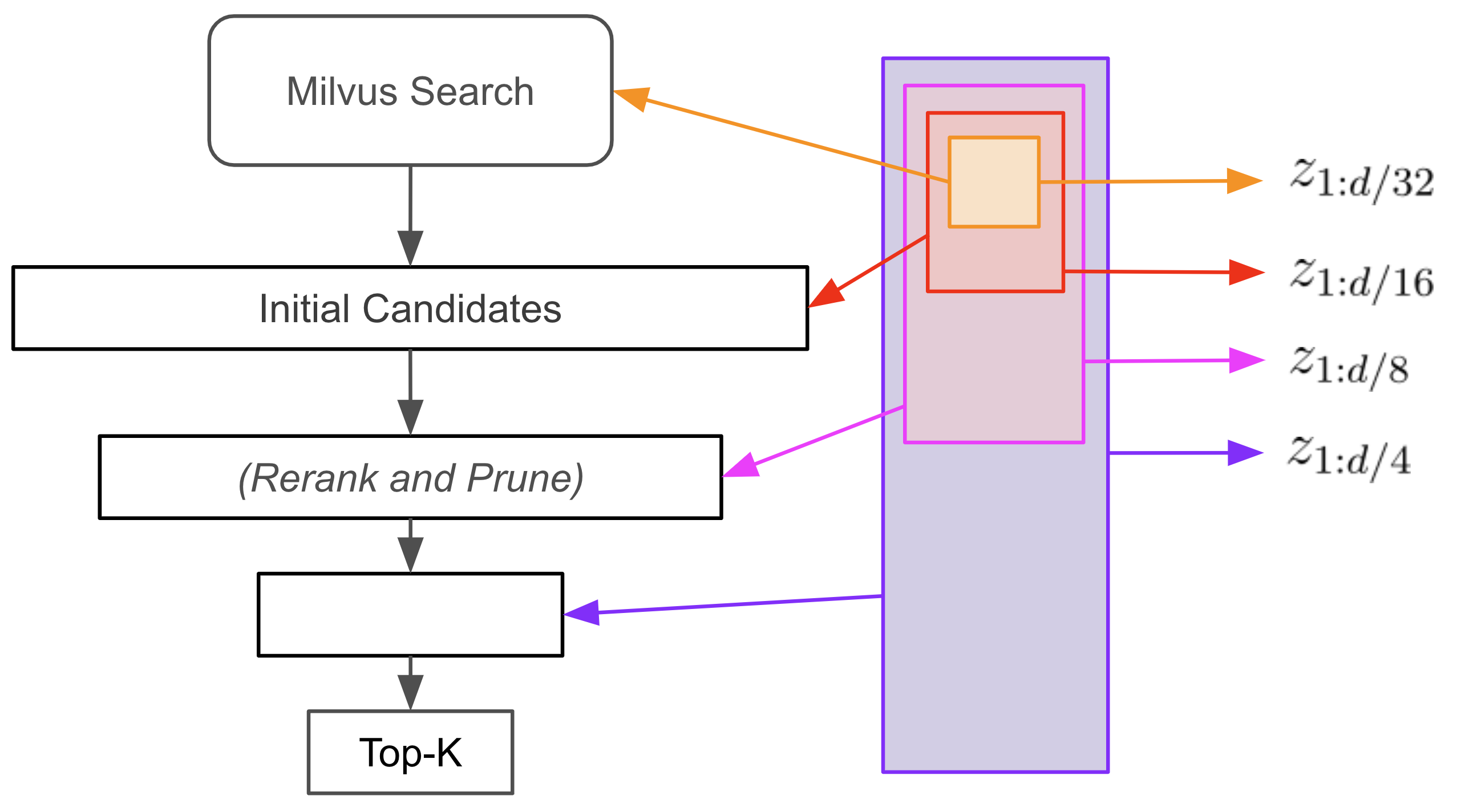
在构建高效的向量搜索系统时,一个关键的挑战是管理存储成本,同时保持可接受的延迟和召回率。现代 Embedding 模型输出的向量有成百上千个维度,这给原始向量和索引带来了巨大的存储和计算开销。
传统方法是在建立索引前应用量化或降维方法来降低存储需求。例如,我们可以使用乘积量化(PQ)降低精度,或使用主成分分析(PCA)降低维数,从而节省存储空间。这些方法会对整个向量集进行分析,以找到一个能保持向量间语义关系的更紧凑的向量集。
这些标准方法虽然有效,但只能在单一尺度上降低一次精度或维度。但是,如果我们能同时保持多层细节,就像一个精确度越来越高的表征金字塔呢?
这就是 Matryoshka Embedding。这些巧妙的结构以俄罗斯嵌套娃娃命名(见插图),将多级表示嵌入到单个向量中。与传统的后处理方法不同,Matryoshka 嵌入在初始训练过程中就能学习这种多尺度结构。结果非常显著:不仅完整的 Embedding 能够捕捉输入语义,而且每个嵌套的子集前缀(前半部分、前四分之一等)都提供了一个连贯的、即使不那么详细的表示。
在本笔记本中,我们将研究如何将 Matryoshka 嵌入与 Milvus 一起用于语义搜索。我们展示了一种名为 "漏斗搜索 "的算法,它允许我们在嵌入维度的一小部分子集上执行相似性搜索,而不会导致召回率急剧下降。
准备工作
$ pip install datasets numpy pandas pymilvus sentence-transformers tqdm
仅用于 CPU:
$ pip install torch torchvision torchaudio --index-url https://download.pytorch.org/whl/cpu
用于 CUDA 11.8
$ pip install torch torchvision torchaudio --index-url https://download.pytorch.org/whl/cu118
CUDA 11.8 的安装命令只是一个示例。安装 PyTorch 时,请确认您的 CUDA 版本。
import functools

from datasets import load_dataset
import numpy as np
import pandas as pd
import pymilvus
from pymilvus import MilvusClient
from pymilvus import FieldSchema, CollectionSchema, DataType
from sentence_transformers import SentenceTransformer
import torch
import torch.nn.functional as F
from tqdm import tqdm
加载 Matryoshka Embedding 模型
我们不使用标准的 Embedding 模型,如 sentence-transformers/all-MiniLM-L12-v2等标准嵌入模型,我们使用的是 Nomic专门为生成 Matryoshka 嵌入而训练的模型。
model = SentenceTransformer(
    # Remove 'device='mps' if running on non-Mac device
    "nomic-ai/nomic-embed-text-v1.5",
    trust_remote_code=True,
    device="mps",
)
<All keys matched successfully>
加载数据集、嵌入项目和构建向量数据库
以下代码是对文档页面"使用句子变形器和 Milvus 进行电影搜索 "中的代码的修改。首先,我们从 HuggingFace 加载数据集。它包含约 35k 个条目,每个条目对应一部有维基百科文章的电影。我们将在本例中使用Title 和PlotSummary 字段。
ds = load_dataset("vishnupriyavr/wiki-movie-plots-with-summaries", split="train")
print(ds)
Dataset({
    features: ['Release Year', 'Title', 'Origin/Ethnicity', 'Director', 'Cast', 'Genre', 'Wiki Page', 'Plot', 'PlotSummary'],
    num_rows: 34886
})
接下来,我们连接到 Milvus Lite 数据库,指定数据 Schema,并用此 Schema 创建一个 Collection。我们将在不同字段中存储非规范化嵌入和嵌入的前六分之一。这样做的原因是,我们需要前 1/6 的 Matryoshka 嵌入来执行相似性搜索,而其余 5/6 的嵌入则用于 Reranking 和改进搜索结果。
embedding_dim = 768
search_dim = 128
collection_name = "movie_embeddings"

client = MilvusClient(uri="./wiki-movie-plots-matryoshka.db")

fields = [
    FieldSchema(name="id", dtype=DataType.INT64, is_primary=True, auto_id=True),
    FieldSchema(name="title", dtype=DataType.VARCHAR, max_length=256),
    # First sixth of unnormalized embedding vector
    FieldSchema(name="head_embedding", dtype=DataType.FLOAT_VECTOR, dim=search_dim),
    # Entire unnormalized embedding vector
    FieldSchema(name="embedding", dtype=DataType.FLOAT_VECTOR, dim=embedding_dim),
]

schema = CollectionSchema(fields=fields, enable_dynamic_field=False)
client.create_collection(collection_name=collection_name, schema=schema)
Milvus 目前不支持对嵌入式子集进行搜索,因此我们将嵌入式分成两部分:头部代表要索引和搜索的向量的初始子集,尾部是剩余部分。该模型是为余弦距离相似性搜索而训练的,因此我们对头部嵌入进行了归一化处理。不过,为了以后计算更大子集的相似性,我们需要存储头部嵌入的规范,因此可以在连接到尾部之前对其进行非规范化处理。
为了通过前 1/6 的嵌入执行搜索,我们需要在head_embedding 字段上创建一个向量搜索索引。稍后,我们将比较 "漏斗搜索 "和常规向量搜索的结果,因此也要在全嵌入上建立一个搜索索引。
重要的是,我们使用的是COSINE 而不是IP 距离度量,因为否则我们就需要跟踪嵌入规范,这会使实现过程变得复杂(在介绍漏斗搜索算法后,这一点会更有意义)。
index_params = client.prepare_index_params()
index_params.add_index(
    field_name="head_embedding", index_type="FLAT", metric_type="COSINE"
)
index_params.add_index(field_name="embedding", index_type="FLAT", metric_type="COSINE")
client.create_index(collection_name, index_params)
最后,我们对所有 35k 部电影的情节摘要进行编码,并将相应的 Embedding 输入数据库。
for batch in tqdm(ds.batch(batch_size=512)):
    # This particular model requires us to prefix 'search_document:' to stored entities
    plot_summary = ["search_document: " + x.strip() for x in batch["PlotSummary"]]

    # Output of embedding model is unnormalized
    embeddings = model.encode(plot_summary, convert_to_tensor=True)
    head_embeddings = embeddings[:, :search_dim]

    data = [
        {
            "title": title,
            "head_embedding": head.cpu().numpy(),
            "embedding": embedding.cpu().numpy(),
        }
        for title, head, embedding in zip(batch["Title"], head_embeddings, embeddings)
    ]
    res = client.insert(collection_name=collection_name, data=data)
100%|██████████| 69/69 [05:57<00:00, 5.18s/it]
执行漏斗搜索
现在,让我们使用 Matryoshka 嵌入维数的前 1/6 来执行 "漏斗搜索"。我有三部要检索的电影,并制作了自己的情节摘要用于查询数据库。我们嵌入查询,然后在head_embedding 字段上执行向量搜索,检索出 128 个结果候选。
queries = [
    "An archaeologist searches for ancient artifacts while fighting Nazis.",
    "A teenager fakes illness to get off school and have adventures with two friends.",
    "A young couple with a kid look after a hotel during winter and the husband goes insane.",
]

# Search the database based on input text
def embed_search(data):
    embeds = model.encode(data)
    return [x for x in embeds]

# This particular model requires us to prefix 'search_query:' to queries
instruct_queries = ["search_query: " + q.strip() for q in queries]
search_data = embed_search(instruct_queries)

# Normalize head embeddings
head_search = [x[:search_dim] for x in search_data]

# Perform standard vector search on first sixth of embedding dimensions
res = client.search(
    collection_name=collection_name,
    data=head_search,
    anns_field="head_embedding",
    limit=128,
    output_fields=["title", "head_embedding", "embedding"],
)
此时,我们已经在更小的向量空间上执行了搜索,因此相对于在完整空间上的搜索,可能会降低延迟并减少对索引的存储要求。让我们来看看每个查询的前 5 个匹配结果:
for query, hits in zip(queries, res):
    rows = [x["entity"] for x in hits][:5]

    print("Query:", query)
    print("Results:")
    for row in rows:
        print(row["title"].strip())
    print()
Query: An archaeologist searches for ancient artifacts while fighting Nazis.
Results:
"Pimpernel" Smith
Black Hunters
The Passage
Counterblast
Dominion: Prequel to the Exorcist

Query: A teenager fakes illness to get off school and have adventures with two friends.
Results:
How to Deal
Shorts
Blackbird
Valentine
Unfriended

Query: A young couple with a kid look after a hotel during winter and the husband goes insane.
Results:
Ghostkeeper
Our Vines Have Tender Grapes
The Ref
Impact
The House in Marsh Road
我们可以看到,由于在搜索过程中截断了 Embedding,因此召回率受到了影响。漏斗搜索通过一个巧妙的技巧解决了这一问题:我们可以利用剩余的嵌入维度对候选列表进行 Reranking 和修剪,从而恢复检索性能,而无需运行任何额外的昂贵向量搜索。
为了便于说明漏斗搜索算法,我们将每个查询的 Milvus 搜索命中率转换为 Pandas 数据帧。
def hits_to_dataframe(hits: pymilvus.client.abstract.Hits) -> pd.DataFrame:
    """
    Convert a Milvus search result to a Pandas dataframe. This function is specific to our data schema.

    """
    rows = [x["entity"] for x in hits]
    rows_dict = [
        {"title": x["title"], "embedding": torch.tensor(x["embedding"])} for x in rows
    ]
    return pd.DataFrame.from_records(rows_dict)

dfs = [hits_to_dataframe(hits) for hits in res]
现在,为了执行漏斗搜索,我们对嵌入的越来越大的子集进行迭代。在每次迭代中,我们都会根据新的相似度对候选项进行 Reranking,并删除部分排序最低的候选项。
具体来说,在上一步中,我们使用 1/6 的嵌入维度和查询维度检索到 128 个候选项。执行漏斗搜索的第一步是使用前 1/3 维度重新计算查询和候选项之间的相似度。我们会剪切掉最下面的 64 个候选项。然后,我们使用前 2/3 个维度重复这一过程,然后使用所有维度,依次剪切到 32 个和 16 个候选维度。
# An optimized implementation would vectorize the calculation of similarity scores across rows (using a matrix)
def calculate_score(row, query_emb=None, dims=768):
    emb = F.normalize(row["embedding"][:dims], dim=-1)
    return (emb @ query_emb).item()

# You could also add a top-K parameter as a termination condition
def funnel_search(
    df: pd.DataFrame, query_emb, scales=[256, 512, 768], prune_ratio=0.5
) -> pd.DataFrame:
    # Loop over increasing prefixes of the embeddings
    for dims in scales:
        # Query vector must be normalized for each new dimensionality
        emb = torch.tensor(query_emb[:dims] / np.linalg.norm(query_emb[:dims]))

        # Score
        scores = df.apply(
            functools.partial(calculate_score, query_emb=emb, dims=dims), axis=1
        )
        df["scores"] = scores

        # Re-rank
        df = df.sort_values(by="scores", ascending=False)

        # Prune (in our case, remove half of candidates at each step)
        df = df.head(int(prune_ratio * len(df)))

    return df

dfs_results = [
    {"query": query, "results": funnel_search(df, query_emb)}
    for query, df, query_emb in zip(queries, dfs, search_data)
]
for d in dfs_results:
    print(d["query"], "\n", d["results"][:5]["title"], "\n")
An archaeologist searches for ancient artifacts while fighting Nazis.
 0           "Pimpernel" Smith
1               Black Hunters
29    Raiders of the Lost Ark
34             The Master Key
51            My Gun Is Quick
Name: title, dtype: object

A teenager fakes illness to get off school and have adventures with two friends.
 21               How I Live Now
32     On the Edge of Innocence
77             Bratz: The Movie
4                    Unfriended
108                  Simon Says
Name: title, dtype: object

A young couple with a kid look after a hotel during winter and the husband goes insane.
 9         The Shining
0         Ghostkeeper
11     Fast and Loose
7      Killing Ground
12         Home Alone
Name: title, dtype: object
我们已经能够在不执行任何额外向量搜索的情况下恢复召回率!从质量上看,这些结果对 "夺宝奇兵 "和 "闪灵 "的召回率似乎高于教程 "使用 Milvus 和 Sentence Transformers 进行电影搜索"中的标准向量搜索,后者使用了不同的 Embedding 模型。然而,它却无法找到我们将在本手册稍后讨论的 "Ferris Bueller's Day Off"(《Ferris Bueller's Day Off》)。(有关更多定量实验和基准测试,请参阅论文Matryoshka Representation Learning)。
比较漏斗搜索和常规搜索
让我们比较一下我们的漏斗搜索和标准向量搜索在相同数据集上使用相同 Embedding 模型的结果。我们对全嵌入进行搜索。
# Search on entire embeddings
res = client.search(
    collection_name=collection_name,
    data=search_data,
    anns_field="embedding",
    limit=5,
    output_fields=["title", "embedding"],
)
for query, hits in zip(queries, res):
    rows = [x["entity"] for x in hits]

    print("Query:", query)
    print("Results:")
    for row in rows:
        print(row["title"].strip())
    print()
Query: An archaeologist searches for ancient artifacts while fighting Nazis.
Results:
"Pimpernel" Smith
Black Hunters
Raiders of the Lost Ark
The Master Key
My Gun Is Quick

Query: A teenager fakes illness to get off school and have adventures with two friends.
Results:
A Walk to Remember
Ferris Bueller's Day Off
How I Live Now
On the Edge of Innocence
Bratz: The Movie

Query: A young couple with a kid look after a hotel during winter and the husband goes insane.
Results:
The Shining
Ghostkeeper
Fast and Loose
Killing Ground
Home Alone
除了 "一名青少年为逃学而装病...... "的搜索结果外,漏斗搜索的结果与完全搜索的结果几乎完全相同,尽管漏斗搜索是在 128 维的搜索空间上进行的,而普通搜索是在 768 维的搜索空间上进行的。
调查《费里斯-布勒的一天》漏斗搜索召回失败的原因
为什么漏斗搜索没有成功检索到《费里斯-布勒的一天》?让我们来看看它是否在原始候选列表中,还是被错误地过滤掉了。
queries2 = [
    "A teenager fakes illness to get off school and have adventures with two friends."
]

# Search the database based on input text
def embed_search(data):
    embeds = model.encode(data)
    return [x for x in embeds]

instruct_queries = ["search_query: " + q.strip() for q in queries2]
search_data2 = embed_search(instruct_queries)
head_search2 = [x[:search_dim] for x in search_data2]

# Perform standard vector search on subset of embeddings
res = client.search(
    collection_name=collection_name,
    data=head_search2,
    anns_field="head_embedding",
    limit=256,
    output_fields=["title", "head_embedding", "embedding"],
)
for query, hits in zip(queries, res):
    rows = [x["entity"] for x in hits]

    print("Query:", queries2[0])
    for idx, row in enumerate(rows):
        if row["title"].strip() == "Ferris Bueller's Day Off":
            print(f"Row {idx}: Ferris Bueller's Day Off")
Query: A teenager fakes illness to get off school and have adventures with two friends.
Row 228: Ferris Bueller's Day Off
我们发现,问题在于初始候选列表不够大,或者说,在最高粒度级别上,所需的点击与查询不够相似。将其从128 改为256 后,检索成功了。我们应该形成一个经验法则,即通过经验评估召回率和延迟之间的权衡,来设定保留集上的候选项数量。
dfs = [hits_to_dataframe(hits) for hits in res]

dfs_results = [
    {"query": query, "results": funnel_search(df, query_emb)}
    for query, df, query_emb in zip(queries2, dfs, search_data2)
]

for d in dfs_results:
    print(d["query"], "\n", d["results"][:7]["title"].to_string(index=False), "\n")
A teenager fakes illness to get off school and have adventures with two friends.
       A Walk to Remember
Ferris Bueller's Day Off
          How I Live Now
On the Edge of Innocence
        Bratz: The Movie
              Unfriended
              Simon Says
顺序重要吗?前缀与后缀嵌入。
经过训练,该模型能够很好地匹配递归较小的前缀嵌入。我们使用的维度顺序是否重要?例如,我们是否也可以提取后缀嵌入的子集?在本实验中,我们颠倒了 Matryoshka 嵌入中维度的顺序,并进行漏斗搜索。
client = MilvusClient(uri="./wikiplots-matryoshka-flipped.db")

fields = [
    FieldSchema(name="id", dtype=DataType.INT64, is_primary=True, auto_id=True),
    FieldSchema(name="title", dtype=DataType.VARCHAR, max_length=256),
    FieldSchema(name="head_embedding", dtype=DataType.FLOAT_VECTOR, dim=search_dim),
    FieldSchema(name="embedding", dtype=DataType.FLOAT_VECTOR, dim=embedding_dim),
]

schema = CollectionSchema(fields=fields, enable_dynamic_field=False)
client.create_collection(collection_name=collection_name, schema=schema)

index_params = client.prepare_index_params()
index_params.add_index(
    field_name="head_embedding", index_type="FLAT", metric_type="COSINE"
)
client.create_index(collection_name, index_params)
huggingface/tokenizers: The current process just got forked, after parallelism has already been used. Disabling parallelism to avoid deadlocks...
To disable this warning, you can either:
    - Avoid using `tokenizers` before the fork if possible
    - Explicitly set the environment variable TOKENIZERS_PARALLELISM=(true | false)
for batch in tqdm(ds.batch(batch_size=512)):
    plot_summary = ["search_document: " + x.strip() for x in batch["PlotSummary"]]

    # Encode and flip embeddings
    embeddings = model.encode(plot_summary, convert_to_tensor=True)
    embeddings = torch.flip(embeddings, dims=[-1])
    head_embeddings = embeddings[:, :search_dim]

    data = [
        {
            "title": title,
            "head_embedding": head.cpu().numpy(),
            "embedding": embedding.cpu().numpy(),
        }
        for title, head, embedding in zip(batch["Title"], head_embeddings, embeddings)
    ]
    res = client.insert(collection_name=collection_name, data=data)
100%|██████████| 69/69 [05:50<00:00, 5.08s/it]
# Normalize head embeddings

flip_search_data = [
    torch.flip(torch.tensor(x), dims=[-1]).cpu().numpy() for x in search_data
]
flip_head_search = [x[:search_dim] for x in flip_search_data]

# Perform standard vector search on subset of embeddings
res = client.search(
    collection_name=collection_name,
    data=flip_head_search,
    anns_field="head_embedding",
    limit=128,
    output_fields=["title", "head_embedding", "embedding"],
)
dfs = [hits_to_dataframe(hits) for hits in res]

dfs_results = [
    {"query": query, "results": funnel_search(df, query_emb)}
    for query, df, query_emb in zip(queries, dfs, flip_search_data)
]

for d in dfs_results:
    print(
        d["query"],
        "\n",
        d["results"][:7]["title"].to_string(index=False, header=False),
        "\n",
    )
An archaeologist searches for ancient artifacts while fighting Nazis.
       "Pimpernel" Smith
          Black Hunters
Raiders of the Lost Ark
         The Master Key
        My Gun Is Quick
            The Passage
        The Mole People

A teenager fakes illness to get off school and have adventures with two friends.
                       A Walk to Remember
                          How I Live Now
                              Unfriended
Cirque du Freak: The Vampire's Assistant
                             Last Summer
                                 Contest
                                 Day One

A young couple with a kid look after a hotel during winter and the husband goes insane.
         Ghostkeeper
     Killing Ground
Leopard in the Snow
              Stone
          Afterglow
         Unfaithful
     Always a Bride
正如预期的那样,召回率比漏斗搜索或常规搜索要差得多(Embedding 模型是通过对嵌入维度的前缀而非后缀进行对比学习来训练的)。
总结
下面是各种方法的搜索结果对比:



我们展示了如何使用 Matryoshka 嵌入和 Milvus 来执行一种更高效的语义搜索算法,即 "漏斗搜索"。我们还探讨了该算法的 Reranker 和剪枝步骤的重要性,以及当初始候选列表太小时的失败模式。最后,我们讨论了维度的顺序在形成子嵌入时的重要性--它必须与模型训练时的顺序一致。或者说,只有因为模型是以某种方式训练的,嵌入的前缀才有意义。现在你知道如何实现 Matryoshka 嵌入和漏斗搜索,以降低语义搜索的存储成本,同时又不会牺牲太多检索性能了吧!