使用 Arize Pheonix 进行评估


本指南演示了如何使用Arize Pheonix评估基于Milvus 的检索增强生成(RAG)管道。
RAG 系统将检索系统与生成模型相结合,根据给定提示生成新文本。该系统首先使用 Milvus 从语料库中检索相关文档,然后使用生成模型根据检索到的文档生成新文本。
Arize Pheonix 是一个帮助您评估 RAG 管道的框架。现有的工具和框架可以帮助您构建这些管道,但评估和量化管道性能可能很难。这就是 Arize Pheonix 的用武之地。
前提条件
在运行本笔记本之前,请确保已安装以下依赖项:
$ pip install --upgrade pymilvus openai requests tqdm pandas "arize-phoenix>=4.29.0" nest_asyncio
如果您使用的是 Google Colab,要启用刚刚安装的依赖项,可能需要重启运行时(点击屏幕上方的 "运行时 "菜单,从下拉菜单中选择 "重启会话")。
在本例中,我们将使用 OpenAI 作为 LLM。您应将api key OPENAI_API_KEY 作为环境变量。
import os

# os.environ["OPENAI_API_KEY"] = "sk-*****************"
定义 RAG 管道
我们将定义使用 Milvus 作为向量存储、OpenAI 作为 LLM 的 RAG 类。该类包含load 方法(将文本数据加载到 Milvus)、retrieve 方法(检索与给定问题最相似的文本数据)和answer 方法(使用检索到的知识回答给定问题)。
from typing import List
from tqdm import tqdm
from openai import OpenAI
from pymilvus import MilvusClient

class RAG:
    """
    RAG(Retrieval-Augmented Generation) class built upon OpenAI and Milvus.
    """

    def __init__(self, openai_client: OpenAI, milvus_client: MilvusClient):
        self._prepare_openai(openai_client)
        self._prepare_milvus(milvus_client)

    def _emb_text(self, text: str) -> List[float]:
        return (
            self.openai_client.embeddings.create(input=text, model=self.embedding_model)
            .data[0]
            .embedding
        )

    def _prepare_openai(
        self,
        openai_client: OpenAI,
        embedding_model: str = "text-embedding-3-small",
        llm_model: str = "gpt-4o-mini",
    ):
        self.openai_client = openai_client
        self.embedding_model = embedding_model
        self.llm_model = llm_model
        self.SYSTEM_PROMPT = """
            Human: You are an AI assistant. You are able to find answers to the questions from the contextual passage snippets provided.
        """
        self.USER_PROMPT = """
            Use the following pieces of information enclosed in <context> tags to provide an answer to the question enclosed in <question> tags.
            <context>
            {context}
            </context>
            <question>
            {question}
            </question>
        """

    def _prepare_milvus(
        self, milvus_client: MilvusClient, collection_name: str = "rag_collection"
    ):
        self.milvus_client = milvus_client
        self.collection_name = collection_name
        if self.milvus_client.has_collection(self.collection_name):
            self.milvus_client.drop_collection(self.collection_name)
        embedding_dim = len(self._emb_text("demo"))
        self.milvus_client.create_collection(
            collection_name=self.collection_name,
            dimension=embedding_dim,
            metric_type="IP",
            consistency_level="Strong",  # Supported values are (`"Strong"`, `"Session"`, `"Bounded"`, `"Eventually"`). See /docs/v2.5.x/userGuide/search-query-get/consistency.md#Consistency-Level for more details.
        )

    def load(self, texts: List[str]):
        """
        Load the text data into Milvus.
        """
        data = []
        for i, line in enumerate(tqdm(texts, desc="Creating embeddings")):
            data.append({"id": i, "vector": self._emb_text(line), "text": line})
        self.milvus_client.insert(collection_name=self.collection_name, data=data)

    def retrieve(self, question: str, top_k: int = 3) -> List[str]:
        """
        Retrieve the most similar text data to the given question.
        """
        search_res = self.milvus_client.search(
            collection_name=self.collection_name,
            data=[self._emb_text(question)],
            limit=top_k,
            search_params={"metric_type": "IP", "params": {}},  # inner product distance
            output_fields=["text"],  # Return the text field
        )
        retrieved_texts = [res["entity"]["text"] for res in search_res[0]]
        return retrieved_texts[:top_k]

    def answer(
        self,
        question: str,
        retrieval_top_k: int = 3,
        return_retrieved_text: bool = False,
    ):
        """
        Answer the given question with the retrieved knowledge.
        """
        retrieved_texts = self.retrieve(question, top_k=retrieval_top_k)
        user_prompt = self.USER_PROMPT.format(
            context="\n".join(retrieved_texts), question=question
        )
        response = self.openai_client.chat.completions.create(
            model=self.llm_model,
            messages=[
                {"role": "system", "content": self.SYSTEM_PROMPT},
                {"role": "user", "content": user_prompt},
            ],
        )
        if not return_retrieved_text:
            return response.choices[0].message.content
        else:
            return response.choices[0].message.content, retrieved_texts
让我们用 OpenAI 和 Milvus 客户端初始化 RAG 类。
openai_client = OpenAI()
milvus_client = MilvusClient(uri="./milvus_demo.db")

my_rag = RAG(openai_client=openai_client, milvus_client=milvus_client)
至于MilvusClient 的参数:
- 将
uri设置为本地文件,如./milvus.db,是最方便的方法,因为它会自动利用Milvus Lite将所有数据存储在此文件中。 - 如果数据规模较大,可以在docker 或 kubernetes 上设置性能更强的 Milvus 服务器。在此设置中,请使用服务器 uri,例如
http://localhost:19530,作为您的uri。 - 如果你想使用Zilliz Cloud(Milvus 的全托管云服务),请调整
uri和token,它们与 Zilliz Cloud 中的公共端点和 Api 密钥相对应。
运行 RAG 管道并获取结果
我们使用Milvus 开发指南作为 RAG 中的私有知识,它是简单 RAG 管道的良好数据源。
下载并将其加载到 RAG 管道中。
import urllib.request
import os

url = "https://raw.githubusercontent.com/milvus-io/milvus/master/DEVELOPMENT.md"
file_path = "./Milvus_DEVELOPMENT.md"

if not os.path.exists(file_path):
    urllib.request.urlretrieve(url, file_path)
with open(file_path, "r") as file:
    file_text = file.read()

text_lines = file_text.split("# ")
my_rag.load(text_lines)
Creating embeddings: 100%|██████████| 47/47 [00:12<00:00, 3.84it/s]
让我们定义一个关于开发指南文档内容的查询问题。然后使用answer 方法获取答案和检索到的上下文文本。
question = "what is the hardware requirements specification if I want to build Milvus and run from source code?"
my_rag.answer(question, return_retrieved_text=True)
('The hardware requirements specification to build and run Milvus from source code are:\n\n- 8GB of RAM\n- 50GB of free disk space',
 ['Hardware Requirements\n\nThe following specification (either physical or virtual machine resources) is recommended for Milvus to build and run from source code.\n\n```\n- 8GB of RAM\n- 50GB of free disk space\n```\n\n##',
  'Building Milvus on a local OS/shell environment\n\nThe details below outline the hardware and software requirements for building on Linux and MacOS.\n\n##',
  "Software Requirements\n\nAll Linux distributions are available for Milvus development. However a majority of our contributor worked with Ubuntu or CentOS systems, with a small portion of Mac (both x86_64 and Apple Silicon) contributors. If you would like Milvus to build and run on other distributions, you are more than welcome to file an issue and contribute!\n\nHere's a list of verified OS types where Milvus can successfully build and run:\n\n- Debian/Ubuntu\n- Amazon Linux\n- MacOS (x86_64)\n- MacOS (Apple Silicon)\n\n##"])
现在,让我们准备一些问题及其相应的地面实况答案。我们从 RAG 管道中获取答案和上下文。
from datasets import Dataset
import pandas as pd

question_list = [
    "what is the hardware requirements specification if I want to build Milvus and run from source code?",
    "What is the programming language used to write Knowhere?",
    "What should be ensured before running code coverage?",
]
ground_truth_list = [
    "If you want to build Milvus and run from source code, the recommended hardware requirements specification is:\n\n- 8GB of RAM\n- 50GB of free disk space.",
    "The programming language used to write Knowhere is C++.",
    "Before running code coverage, you should make sure that your code changes are covered by unit tests.",
]
contexts_list = []
answer_list = []
for question in tqdm(question_list, desc="Answering questions"):
    answer, contexts = my_rag.answer(question, return_retrieved_text=True)
    contexts_list.append(contexts)
    answer_list.append(answer)

df = pd.DataFrame(
    {
        "question": question_list,
        "contexts": contexts_list,
        "answer": answer_list,
        "ground_truth": ground_truth_list,
    }
)
rag_results = Dataset.from_pandas(df)
df
/Users/eureka/miniconda3/envs/zilliz/lib/python3.9/site-packages/tqdm/auto.py:21: TqdmWarning: IProgress not found. Please update jupyter and ipywidgets. See https://ipywidgets.readthedocs.io/en/stable/user_install.html
  from .autonotebook import tqdm as notebook_tqdm
Answering questions: 100%|██████████| 3/3 [00:03<00:00,  1.04s/it]
| 问题 | 上下文 | 答案 | 地面真相 | |
|---|---|---|---|---|
| 0 | 硬件要求是什么? | [硬件要求(Hardware Requirements/n):以下是硬件要求规格。 | 构建 Milvus 的硬件要求规范... | 如果您想构建 Milvus 并从源代码中运行... |
| 1 | 用什么编程语言来编写 Milvus... | [CMake & Conan\n\nMilvus 的算法库... | 编写 Knowherus 的编程语言是什么? | 用来编写知乎的编程语言... |
| 2 | 运行代码覆盖前应确保什么? | [代码覆盖(Code coverage):在提交您的 pull... | 在运行代码覆盖之前,应该确保... | 在运行代码覆盖之前,应该确保 ... |
使用 Arize Phoenix 进行评估
我们使用 Arize Phoenix 来评估我们的检索增强生成(RAG)管道,重点关注两个关键指标:
-
幻觉评估:确定内容是事实还是幻觉(没有上下文依据的信息),确保数据完整性。
- 幻觉解释:解释回复是否符合事实的原因。
-
QA 评估:评估输入查询的模型答案的准确性。
- QA 解释:详细说明答案正确或不正确的原因。
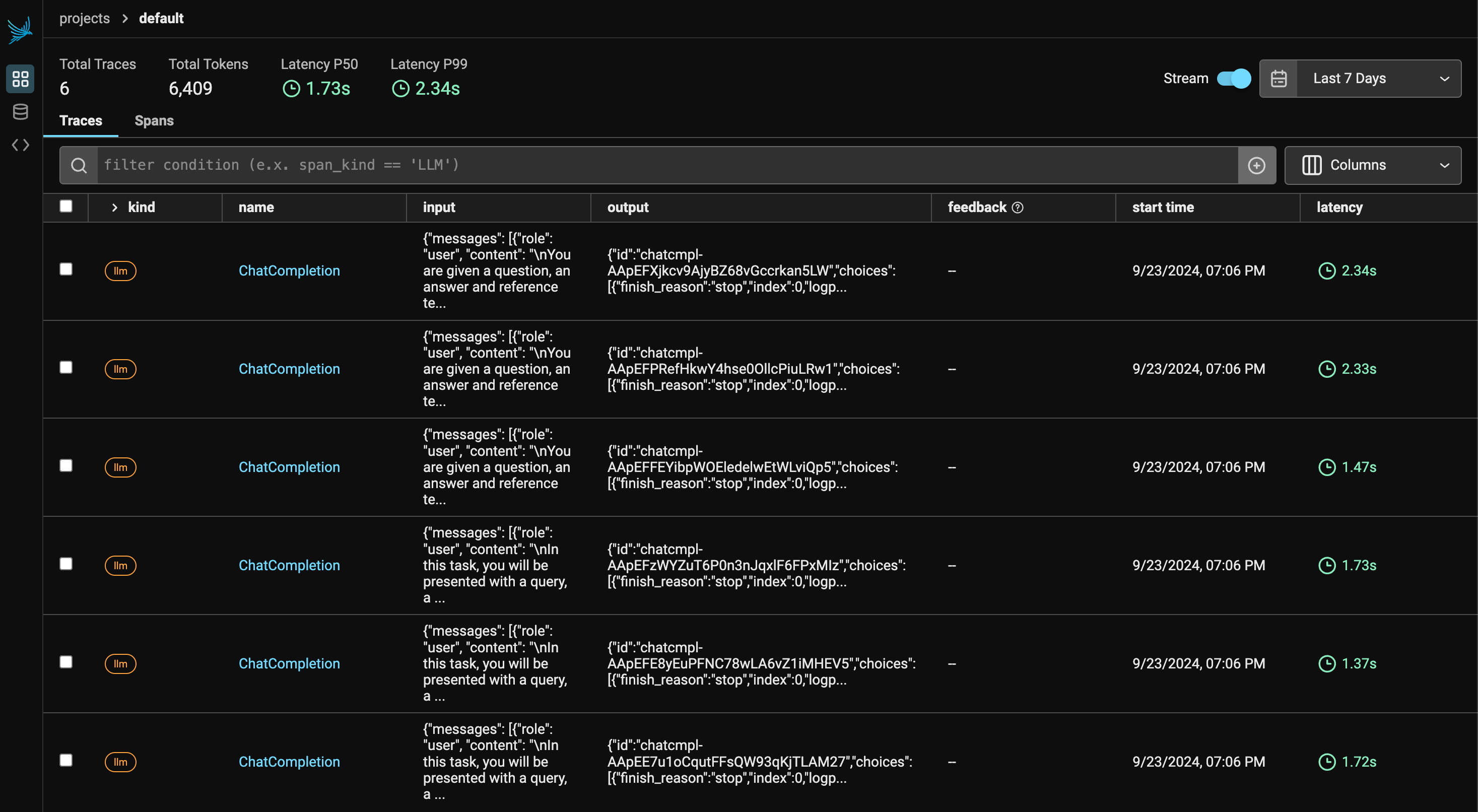
Phoenix 跟踪概述
Phoenix 为 LLM 应用程序提供与 OTEL 兼容的跟踪功能,并与Langchain、LlamaIndex 等框架以及OpenAI和Mistral 等 SDK 集成。跟踪功能可捕获整个请求流,深入了解以下内容:
- 应用程序延迟:识别并优化缓慢的 LLM 调用和组件性能。
- 令牌使用情况:分解令牌消耗,优化成本。
- 运行时异常:捕捉速率限制等关键问题。
- 检索文档分析文档检索、得分和顺序。
利用 Phoenix 的跟踪功能,您可以识别瓶颈、优化资源,并确保各种框架和语言的系统可靠性。
import phoenix as px
from phoenix.trace.openai import OpenAIInstrumentor

# To view traces in Phoenix, you will first have to start a Phoenix server. You can do this by running the following:
session = px.launch_app()

# Initialize OpenAI auto-instrumentation
OpenAIInstrumentor().instrument()
🌍 To view the Phoenix app in your browser, visit http://localhost:6006/
📖 For more information on how to use Phoenix, check out https://docs.arize.com/phoenix
 文本
文本
import nest_asyncio

from phoenix.evals import HallucinationEvaluator, OpenAIModel, QAEvaluator, run_evals

nest_asyncio.apply()  # This is needed for concurrency in notebook environments

# Set your OpenAI API key
eval_model = OpenAIModel(model="gpt-4o")

# Define your evaluators
hallucination_evaluator = HallucinationEvaluator(eval_model)
qa_evaluator = QAEvaluator(eval_model)

# We have to make some minor changes to our dataframe to use the column names expected by our evaluators
# for `hallucination_evaluator` the input df needs to have columns 'output', 'input', 'context'
# for `qa_evaluator` the input df needs to have columns 'output', 'input', 'reference'
df["context"] = df["contexts"]
df["reference"] = df["contexts"]
df.rename(columns={"question": "input", "answer": "output"}, inplace=True)
assert all(
    column in df.columns for column in ["output", "input", "context", "reference"]
)

# Run the evaluators, each evaluator will return a dataframe with evaluation results
# We upload the evaluation results to Phoenix in the next step
hallucination_eval_df, qa_eval_df = run_evals(
    dataframe=df,
    evaluators=[hallucination_evaluator, qa_evaluator],
    provide_explanation=True,
)
run_evals |██████████| 6/6 (100.0%) | ⏳ 00:03<00:00 | 1.64it/s
results_df = df.copy()
results_df["hallucination_eval"] = hallucination_eval_df["label"]
results_df["hallucination_explanation"] = hallucination_eval_df["explanation"]
results_df["qa_eval"] = qa_eval_df["label"]
results_df["qa_explanation"] = qa_eval_df["explanation"]
results_df.head()
| 输入 | 上下文 | 输出 | 地面实况 | 上下文 | 参考 | 幻觉评估 | 幻觉解释 | qa_eval | qa_explanation | |
|---|---|---|---|---|---|---|---|---|---|---|
| 0 | 硬件要求是什么? | [硬件要求(Hardware Requirements/n... | 构建 Milvus 的硬件要求规范... | 如果您想从源代码中构建并运行 Milvus... | [硬件要求(Hardware Requirements):以下是对硬件要求的具体说明。 | [硬件要求(Hardware Requirements):以下是对硬件要求的具体说明... | 事实 | 要确定答案是事实还是幻... | 正确 | 要确定答案是否正确,我们需要... |
| 1 | 用什么编程语言编写... | [CMake & Conan\n\nThe algorithm library of Mil... | 编写知乎的编程语言是什么? | 用来编写知乎的编程语言是什么? | [CMake & Conan\n\nThe algorithm library of Mil... | [CMake & Conan\nThe algorithm library of Mil... | 事实 | 确定答案是事实性的还是含糊... | 正确 | 要确定答案是否正确,我们需要... |
| 2 | 运行代码覆盖前应确保什么? | [代码覆盖(Code coverage/n/n)在提交您的 pull ... | 在运行代码覆盖之前,应该确保... | 在运行代码覆盖之前,应该确保 ... | [在提交你的 pull 之前... | [在运行代码覆盖之前,应该确保 ... | 事实 | 参考文献规定,在运行代码覆盖之前... | 正确 | 要确定答案是否正确,我们需要... |